Built on a Marsh
Script
by Nilakash Roy-Faderman
Our house was built on a marsh.
A lot of the land around the San Francisco Bay used to be marshland. Masses of pickleweed and saltgrass, the cry of birds, the smell of sulfur. But it hasn’t been like that since the time the Tamien lived here, the people who knew the marsh, who piled the shellmounds, who built boats and houses out of tule. That wasn’t very long ago. But it was long enough for people to forget.
Maybe the trouble started in the 1800s, when the farmers moved in. You can farm in the hills fine. But you can’t build an orchard on a marsh, and you can’t build a house on a marsh, and people need places to live.
So they covered up the marshland with landfill. They piled on temporary housing and orchards and cornfields. They killed or drove out as many Tamien as they could. And they pretended that there had never been anything before them.
Maybe the trouble started in the 50s, when Lockheed Martin moved here. They cleared out the orchards and sweetcorn farms to make way for factories and offices. They covered the landfill with cars and concrete and rows of identical Eichler houses.
Maybe the trouble started in the late 60s, when Intel moved here. They needed factories and offices too. And that meant more people to staff them, and more workers, and row after row of shabbily built imitation Eichlers. The people dumped their rubbish, the factories dumped their toxins - down, down, down below the concrete and the landfill, down into the marsh.
(In a neighbourhood a mile away from my house, they’re still finding TCE in the groundwater. Unlike people, the marsh has a very long memory.)
People kept on coming, though. First the semiconductor companies, then the computer companies, then the software companies and the dotcom companies and the web browser and social media companies, and they each needed more workers, and more workers meant more houses. So they covered more marsh with concrete, built shoddy prefab homes in a desperate attempt to keep up with the demands of too many corporations crowded into too small a space. More and more, until the houses covered the marshland so completely you can almost forget it’s there.
But you can’t kill the marsh. You can kill the people who live there. You can kill the plants who live there and the animals who live there. You can smother it all in landfill and coat it in concrete. But the marsh, the shifting hungry earth that is not quite land and not quite water, remains.
Our house has begun to sink.
You can’t see it. The floor looks level. But the doors are shifting out of alignment with their frames. There are cracks in the walls that weren’t there a year ago. The last time we tried to hang a picture we learned that the floor is no longer aligned with the windows.
The whole land is sinking, now. Sinking under the freeways weighed down by the cars of people on hour-long commutes to their job in a city they can’t afford to live in. Sinking under the poorly-built prefab homes heavy with three families stuffed in a house designed for one because that’s the only way they can pay the rent. Silicon Valley is a depression in the world, a ball of lead on a rubber sheet, pulling in everyone around it only to crush them under its weight. And the people who have placed that weight there - who raise the rent and lower the wages - they have moved uphill from us, and it is only after we have sunk completely through the landfill and into the mud that they will feel the brackish water lapping at their toes.
For now, we sink. We live on our floating island on a landfill on a marsh, and we make it our home. And in the cracking walls and the shifting doors I find comfort, because I know that after we are gone, the house will go, and the concrete will go, and the landfill will go, and there will be the wet half-land of the marsh. And someday, there might be pickleweed. And saltgrass. And the cry of birds. And the smell of sulfur.
Our house was built on a marsh.
Someday there will be a marsh on our house.
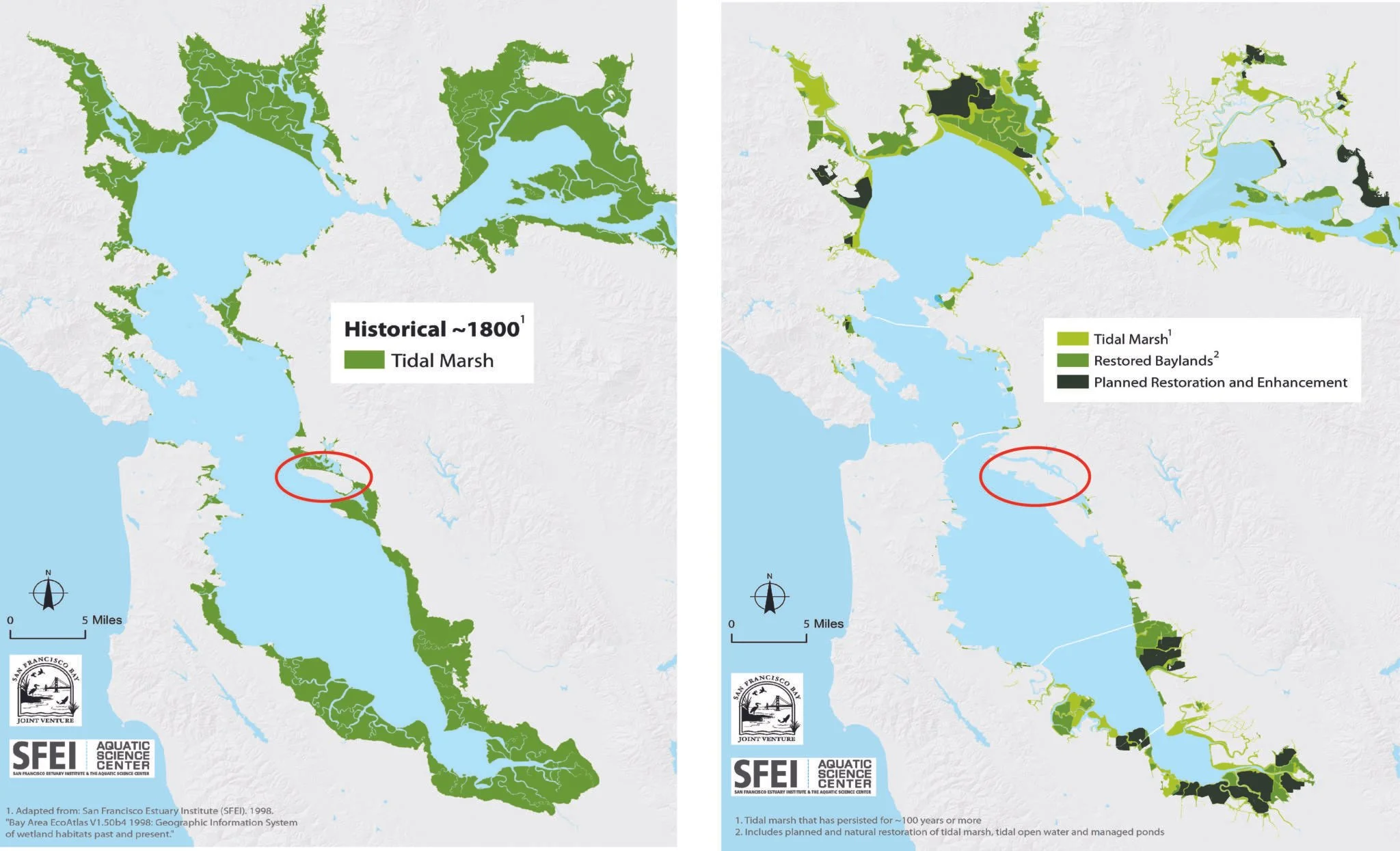
Comparison in tidal wetland habitat between the 1800s and present day in the San Francisco Bay Area. From the San Francisco Estuary Institute.